I specialize in stellar dynamics. My work focuses on two main areas: the dynamics and morphology of the Milky Way spiral arms, combining theoretical models and observational data, and the dynamical evolution of star clusters, modelled using N-body simulations.

I studied Physics at the Autonomous University of Puebla. Later, I earned my Master’s and Ph.D. in Sciences specializing in Physics at CINVESTAV, under the supervision of Dr. Tonatiuh Matos Chassin, working with the scalar field model as dark matter. I completed my first postdoctoral stay at the Institute of Astronomy at UNAM, collaborating with Dr. Bárbara Pichardo on the study of the internal dinamics in spiral galaxies: radial migration, stellar heating, chemo-dynamics of the stellar disk and tidal disruption of open clusters. Later, I undertook a second postdoctoral stay at the University of Surrey, UK, working with N-body models on the dynamics and evolution of globular clusters.

Research Interests

Stellar Dynamics

Spiral Arms & Bars

Rotation Curves

Radial Migration

Star Clusters

N-body Simulations

A 3D Chemical Map of the Milky Way's Spiral Structure

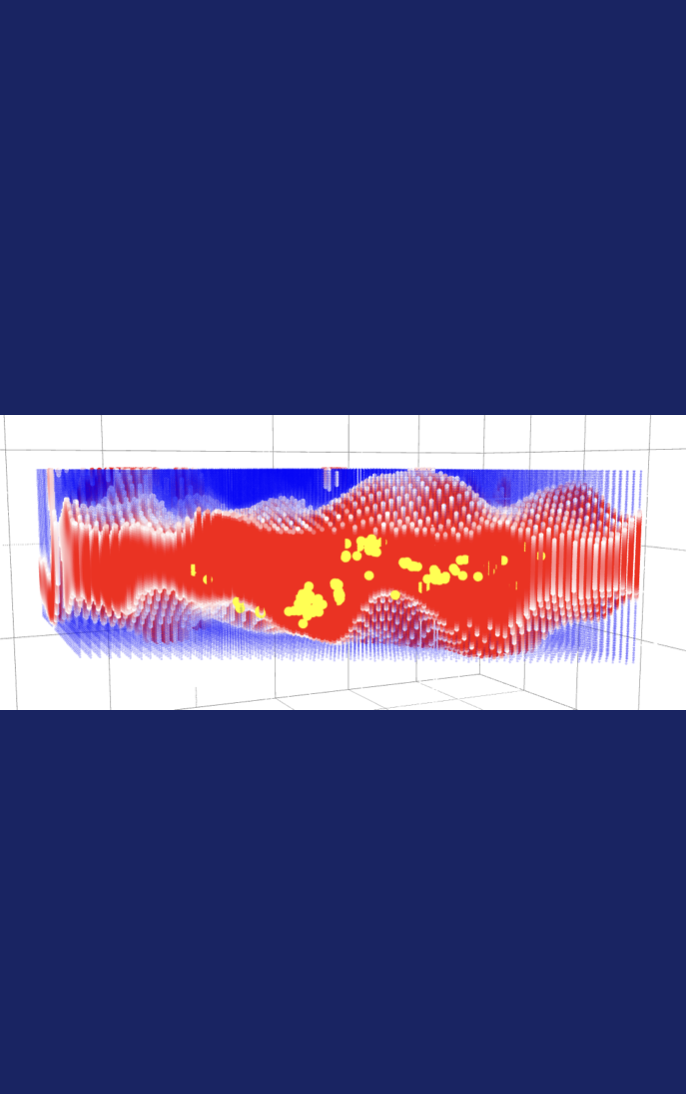
Mapping the Milky Way spiral arms in the vertical direction remains a challenging task that has received little attention. We analyse a sample of young giant stars from Gaia DR3 and use their metallicity distribution to produce a 3D metallicity excess map. The map shows signatures of the spiral arms, whose vertical height vary across the Galactic disc, reaching up to 400 pc in amplitude and exhibiting vertical asymmetries with respect to the midplane. Specifically, the Perseus arm displays a high vertical asymmetry consistent with the Galactic warp.
We find evidence of a metal-rich stellar structure that undulates nearly in phase with the Radcliffe Wave. This new structure is larger and extends beyond the Radcliffe Wave, reaching vertical amplitudes of 270 pc and extending for at least 4 kpc in length. We confirm that for at least half of its length this Extended Radcliffe Wave is the inner edge of the Local Arm. The finding of a metal-rich stellar counterpart of the Radcliffe Wave shows that mapping the three-dimensional metallicity distribution of young stellar populations reveals key information about the structures and chemical enrichment in the Galactic disc. See Martinez-Medina et al. 2025

➤ Click here to explore the interactive 3D maps used in the paper
Globular Cluster Evolution in Dwarf Galaxies

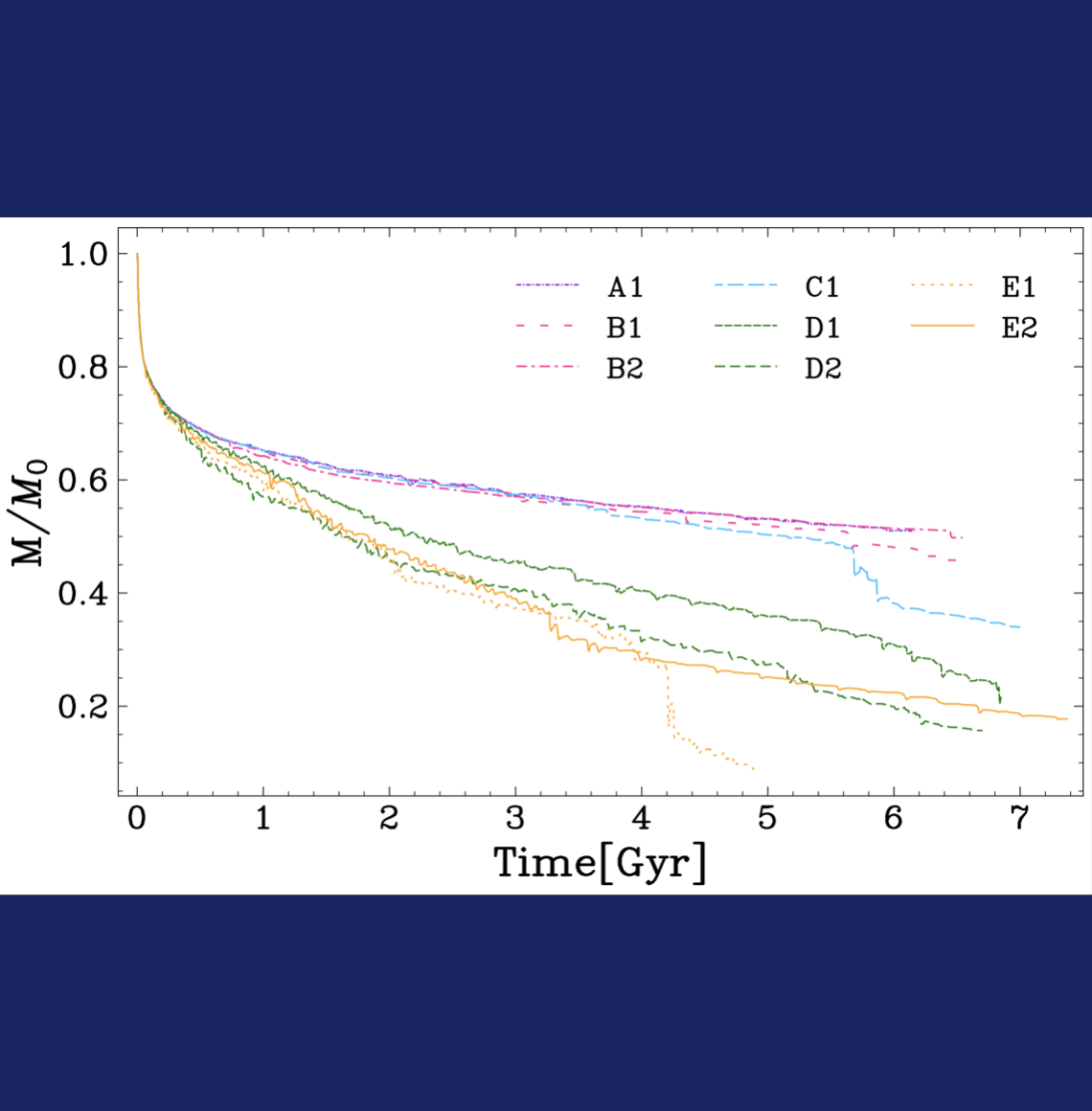
In this work, we explore how globular clusters evolve over time within dwarf galaxies and how that evolution affects their observed numbers. Our results show that lower-mass dwarf galaxies are less efficient at disrupting their clusters, meaning more of them survive. This helps explain trends in the number of globular clusters seen across different dwarf galaxies and links cluster survival to the mass and environment of their host galaxy. See Moreno-Hilario et al. 2024